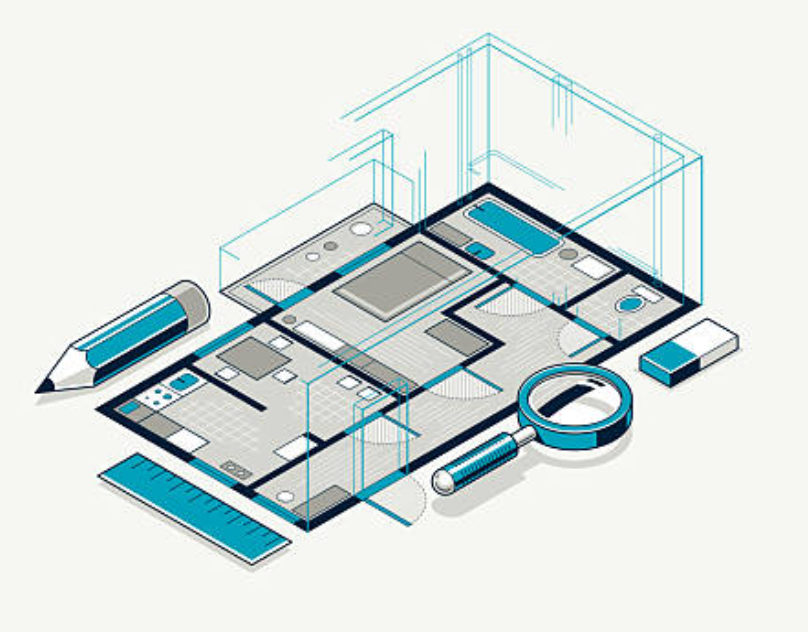
For four years, we've built custom AI solutions spanning the real estate ecosystem, from automation underwriting and valuation models to image intelligence, and agent-assist systems. Still, one such capability has proven time and again to be far more impactful than most people realize: training AI to understand floor plans accurately.
On the surface, the floor plans are clean and structured. In reality, anyone who has worked with a scanned PDF or broker-uploaded images knows how messy they really are. Skewed scans, hand-drawn geometry, faded text, overlapping sets of annotations, mixed measurements-the list goes on and on. To humans, they make complete sense. To machines, they're chaos and cleaning up that chaos is very crucial towards industry-wide automation.
Once the AI is able to understand a floor plan reliably, extract geometry, and understand spatial relationships, then for any company involved in Real estate software development, an entire universe of automation becomes possible. Such a capability creates proprietary intelligence for both design and investment decisions:
Over the last two years, we have pushed the boundaries of Computer Vision, OCR, and geometric reasoning to build a reliable floor-plan intelligence engine. We consider this highly specialized development as one of the core components of our AI development services. To do this, we break down the problem into these five critical stages:
First, it stabilizes the input-skewed scans, cleans the noise, normalizes line thickness, and prepares the messy image for robust detection, hence guaranteeing reliable segmentation even when the inputs are of poor quality or hand-drawn.
We perform the detection and segmentation of walls, openings (doors, windows), fixtures (sinks, stoves), and structure by using deep learning models. This step identifies every part of the building no matter how clear the drawing may be.
We run OCR models tuned for architectural fonts, symbols, and abbreviations to identify room names, specific dimensions, and material labels. In this way, it is ensured that the extracted text is meaningful within the architectural context.
This is where the magic happens: room polygons are reconstructed, adjacency graphs are created, and circulation-understanding how people move through space-is derived. This process produces clean, structured spatial data from the flat drawing.
The final system outputs client-ready formats such as GeoJSON, SVG, CSV, and BIM-compatible object structures. The complex and messy plans get turned into reliable digital twins that are directly usable for costing, analysis, or redesign.
A floor plan is one of the most basic, yet highly underestimated, data sources in real estate. This document holds crucial information on livability, energy efficiency, renovation potential, and compliance. Our systems make the documents actionable intelligence for companies involved in real estate, construction, and interior design.
The goal of one of our recent projects was to build an AI engine capable of taking noisy plans from PDFs and outputting clean, structured spatial representations instantaneously. The result was a proprietary system that transforms unstructured architectural drawings into actionable intelligence for investment and planning decisions, proving the value of custom development. By teaching AI to understand space in the same way as humans, we build the future foundation of real estate intelligence.
Specialization is key to winning in PropTech. If your company is serious about advancing its technology, you need dedicated AI development services that understand the subtleties of the built environment. Our expertise in Computer Vision and Geometric Reasoning ensures that you transition successfully from slow, unreliable processes to fast, scalable intelligence. Ready to build the future foundation of real estate intelligence? Book your free discovery session today and let our specialists design a Custom AI Solutions tailored to your exact business needs.
Unlock PropTech automation. Learn how our custom AI uses Computer Vision and geometric reasoning to extract data from floor plans, reducing costs.

.png)
Automate grading, curriculum mapping, and student records. See 5 top use cases where IDP and OCR transform academic operations.
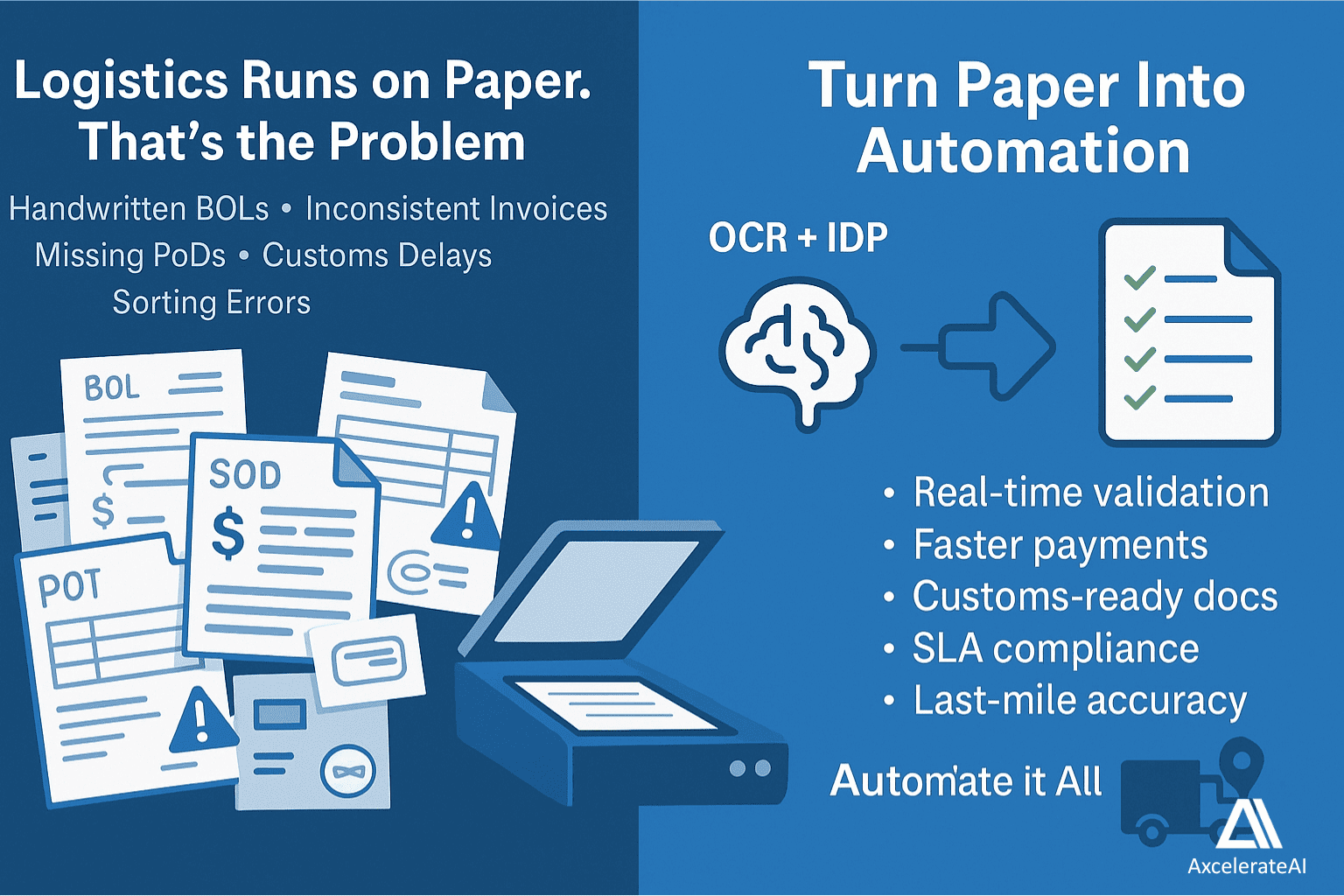
Unlock logistics efficiency with OCR and IDP: Automate inventory, supply chain tracking, and compliance. See real examples from DHL and Maersk.
Unlock PropTech automation. Learn how our custom AI uses Computer Vision and geometric reasoning to extract data from floor plans, reducing costs.
Automate grading, curriculum mapping, and student records. See 5 top use cases where IDP and OCR transform academic operations.
Unlock logistics efficiency with OCR and IDP: Automate inventory, supply chain tracking, and compliance. See real examples from DHL and Maersk.

AxcelerateAI offers cutting-edge AI solutions, specialising in building and deploying custom machine learning models to help businesses optimise operations, enhance decision-making, and drive growth.